
Smaller fish
On the eve of the runoff, ten days in the Vale do Javari, and what no election can explain
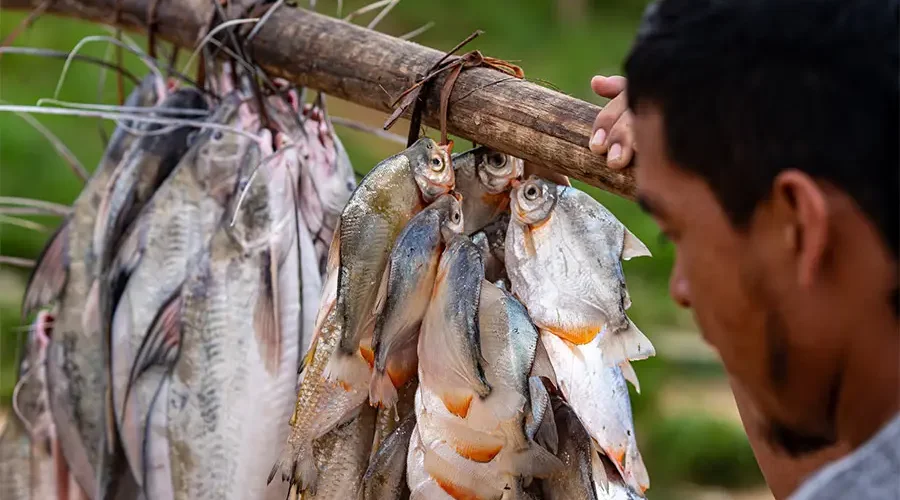
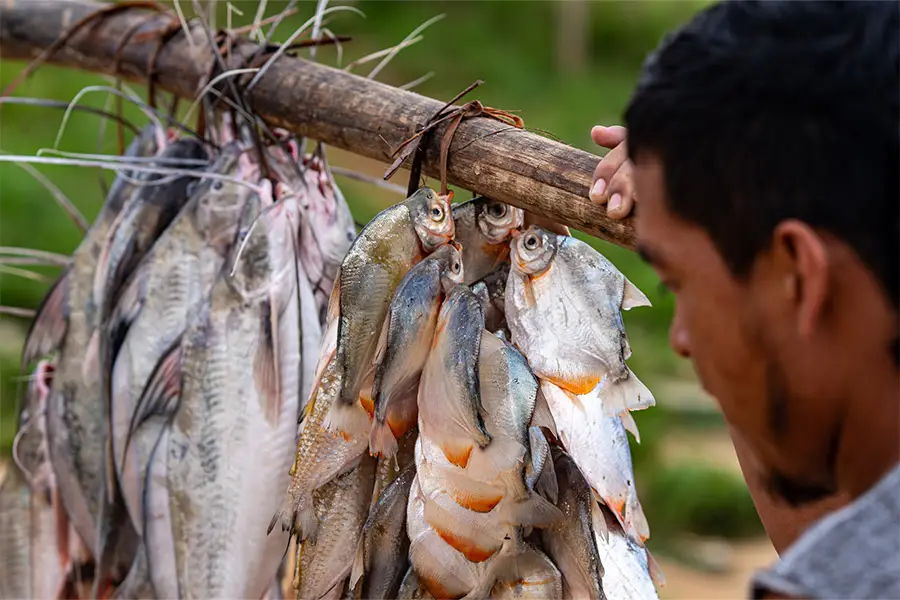
In the Javari Valley, fishermen report a decline in fish. Along the banks of rivers affected by drought and scarcity, smaller fish
reflect a reality that no national election can explain. Photo: Marcos Colón / Amazonia Latitude.
 Portugués
 Espanhol
I recently spent ten days in the Vale do Javari (Javari Valley), in the far west of the state of Amazonas, on the border with Peru. I returned in fear. Not of the drought or the hardships I witnessed in the communities, although these too weigh heavily. I came back afraid of what could happen in this part of the Amazon in the case of a win for Flávio Bolsonaro.
I realize that the problems in Javari did not start with Jair Bolsonaro and that they can’t be solved by an election. But what I found on this trip made me think about how much we still fail to see the Amazon when we interpret it only through the prism of the national political dispute.
In Javari, the region with the world’s largest concentration of isolated indigenous peoples, life goes on at a pace that has little to do with the electoral calendar. The rivers determine how people get around, their access to food, and the possibility of work. This year’s drought has made an already precarious situation even more difficult.
I accompanied fishers that find smaller and smaller fish. I can’t say how much of this is down to the drought, the pressure on resources, or other factors. I know what I saw and what I heard. For those who depend on the river, this shrinkage is not an abstraction; it affects food, income, the next day.
Meanwhile, Brazil argues over the election.
I spoke to young people from Benjamin Constant and university students that believe that Flávio Bolsonaro is the best choice for their futures. Some benefit from public policies that are historically rare in that part of the country. Even so, they support a project that has a relationship with public education, environmental protection and indigenous rights that requires, at least, a closer look.
Meeting people that think differently to me is not what worries me. It is realizing how political identification speaks louder than the reality that these same people live. The environmental and territorial legacy of Jair Bolsonaro’s government appears to carry little weight in these conversations, and it is not due to simple ignorance. There are legitimate frustrations, a deep mistrust of institutions, and the desire to belong to a national project which, for many, seems not to have a place for them.
In Tabatinga, a taxi driver told me he would vote for Flávio Bolsonaro. His justification was straightforward: the indigenous receive Bolsa Família (Family Allowance) and have better access to medical services than he does. Those who know about the difficulties for indigenous health in that region know that this is far from the truth. But what was most important in that conversation wasn’t the erroneous information, it was the resentment.
The taxi driver wasn’t talking about the indigenous, he was talking about feeling abandoned. For him, having policies aimed at other groups means that the State has chosen who deserves attention and who is left out. I was left thinking on how precarious situations can transform people that face the same problems into adversaries. Rather than demanding medical services fit for all, discontent can turn vulnerable people against those who also need protection.
Lula won the first round of voting in Benjamin Constant and Tabatinga, but the electoral maps do not explain what happens there. Although the conversations that I had are not representative of the entire population, they reveal a contradiction that the numbers do not show.
In June, I traveled through the same region for ten days, from Tabatinga to the Estirão do Norte, part of the way on an Israelita community ferry. For days, in an extensive and sensitive area on the border with Peru, I saw no patrols. The State is still there, their presence is precarious, irregular, and insufficient, but they are there. And it is exactly that which is in play in this election: the difference between strengthening a fragile presence or destroying what remains of it.
The Amazon appears in political discourse as a question of sovereignty: protect the borders, defend the national riches. But what does sovereignty mean for those who depend on the river and have scarce access to basic services? The sovereignty that matters to this population is not on the map. It needs to be felt in daily life.
Carlos Walter Porto-Gonçalves has already shown that there is not one Amazon, but many, marked by different histories, populations, and interests. Today, the region occupies a central place in negotiations on the climate, carbon, and biodiversity. It has immense visibility, but the attention rarely corresponds to an understanding of life for those who live there. We know the rates of deforestation, but we hear little about the fishers. We defend indigenous territories without understanding the tensions between the indigenous and the non-indigenous in Amazonian cities.
Protection of the forest, even when necessary, is not always accompanied by policies that answer to those who live inside it. The Amazon is not a void waiting for someone to decide its fate. It is inhabited by peoples that constructed ways of life and relationships with the territory long before the existence of the State. It is also inhabited by urban populations, migrants, workers, and young people seeking opportunities that do not necessarily share the same vision of the future of the region.
This is the Amazon that does not fit into the campaign speeches. On any side.
I look fearfully at the possibility of a victory for Flávio Bolsonaro. Not only because of the legacy of his father’s government, but because I have seen up close what happens to a border when the State disappears. And I do not believe that a victory for Lula will, in itself, solve what I have found. The problems have roots that go beyond governments. The Amazon has already paid a high price for decisions taken far away, without the participation of who actually lives there.
What is at stake is not the continuity or change of government. It is the possibility of increasing or reducing the capacity of these populations to make decisions about their own territories. The question that I can’t ignore ever since I returned is simple: what do we fail to see in the Amazon when we interpret everything through the election?
The national debate tends to treat elections as a symmetrical dispute: two projects, two visions, one choice between sides. But what I have seen in Javari does not fit into this symmetry. The issue is not which political model will govern the State. It is whether the already fragile State that remains in the region will survive. Why do young people that depend on public education support someone who threatens to dismantle it? Why does a worker that the State ignores see indigenous rights as a privilege? Why do we talk so much about sovereignty in a place where the State barely appears?
I think about the fishers, the university students, and the taxi driver in Tabatinga. They are different stories that reveal the same abyss: the distance between the Amazon that appears in the national debate and the one its inhabitants face every day.
The day after the election, they will still be there. The fishers will return to the rivers. The young people will still be looking for a future. The indigenous peoples will still be defending their territories.
The election will end. For those who live in the Amazon, its consequences could last much longer than four years.
Marcos Colón is the Southwest Borderlands Initiative Assistant Professor of Media and Indigenous Communities at Arizona State University’s Walter Cronkite School of Journalism and Mass Communication. He is the director of Beyond Fordlândia (2018) and Stepping Softly on the Earth (2022), and is the author of The Amazon in Times of War (Practical Action Publishing & Latin America Bureau, 2024, published in Spanish as La Amazonía en tiempos de guerra, Planeta, 2025); and organizer of Utopias Amazônicas (Ateliê, 2025).
Finishing: Juliana Carvalho
Editorial Director: Marcos Colón



